Furniture materials: how they behave on site and what it means for installation
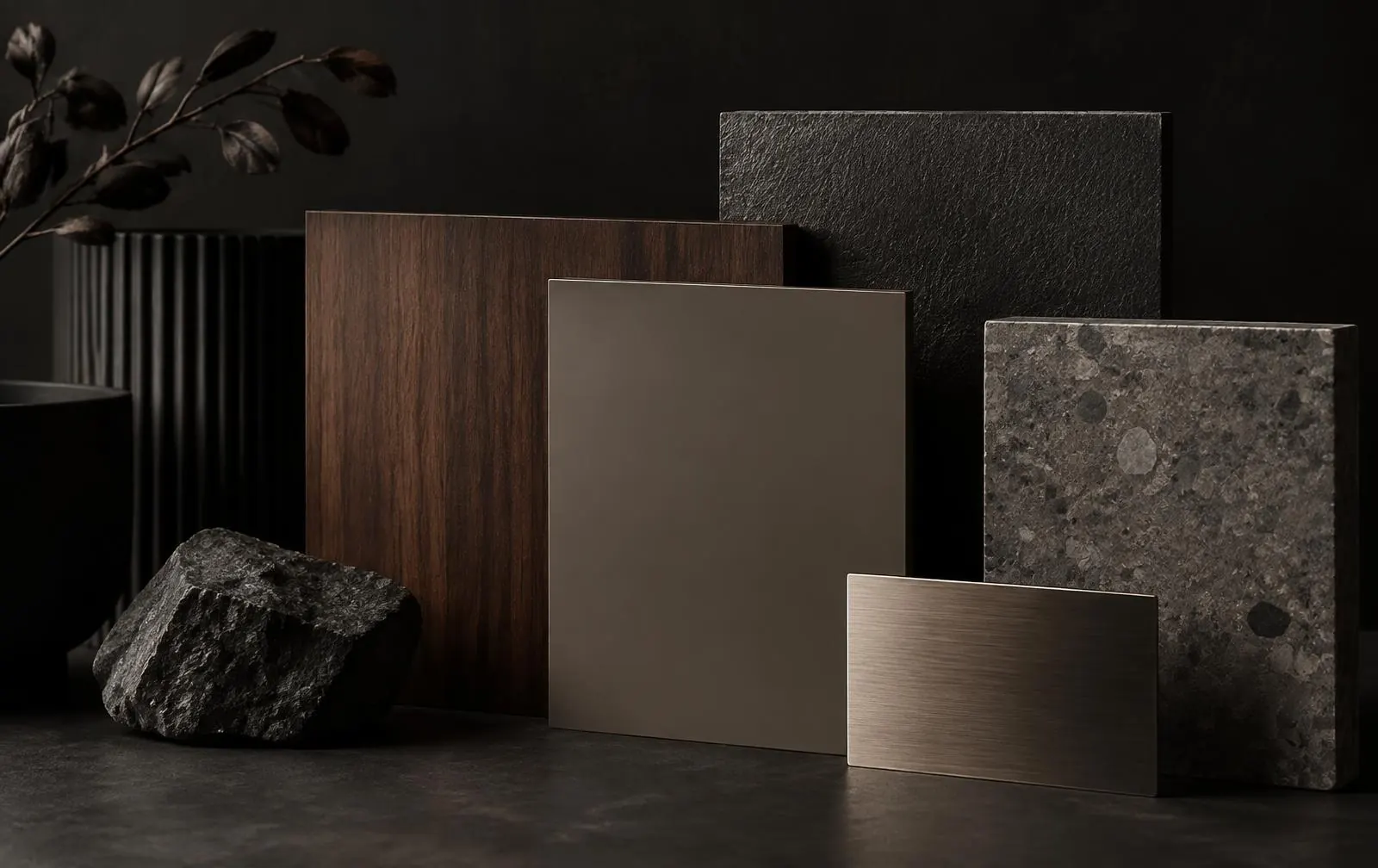
Solid timber, veneer, lacquered MDF, HPL, stone composite, ceramics and metal — each material has its own rules. A practical guide for installation and care.
The material dictates the installation sequence
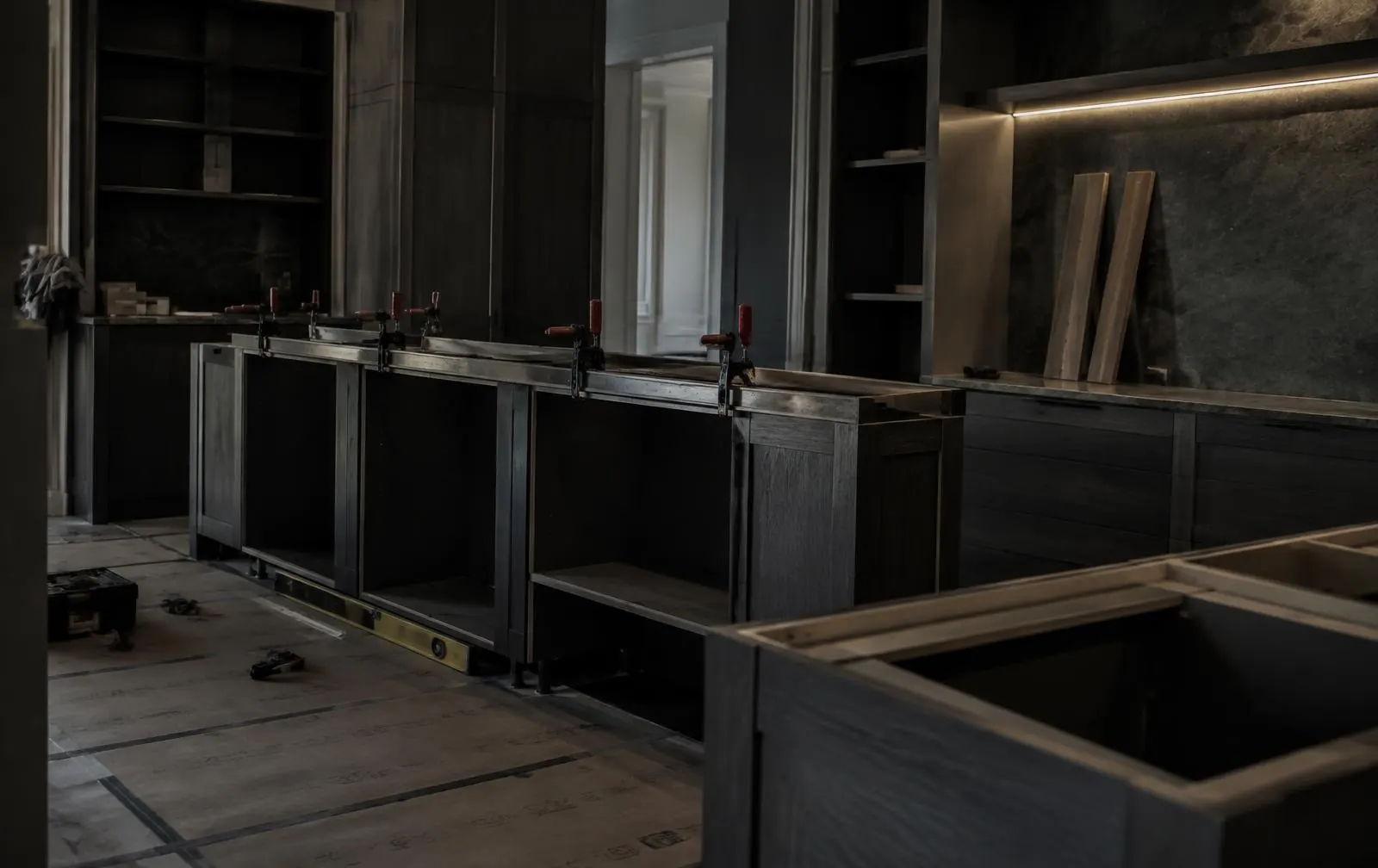
Before installation begins it matters not only how a piece looks but what it is made of. The material determines which tool may touch the surface, how long the piece can wait on site, how it reacts to humidity and which deviation will be visible. The same wardrobe in lacquered MDF and in oak veneer is installed differently.
Solid timber: a living material
Solid timber expands and contracts across the grain with humidity. That is why a wide solid component is never fixed rigidly across its full width — slotted holes or sliding fixings are required. Installed without room to move, it will either split or twist the carcass.
On site we keep solid timber away from heaters and direct sunlight, and install only when room humidity is stable. Oiled surfaces demand clean gloves: fingerprints on freshly oiled oak stay visible.
Veneer and veneered MDF: direction matters
The greatest value of veneered fronts is a continuous grain across several doors. That means components cannot be swapped. During installation every part must be marked to the drawing, and packages opened in the order of installation.
A veneered surface is sensitive to water at the edges and to sanding dust. We cut in another room or with extraction and protect the edges immediately after scribing.
Matte lacquer and supermatte surfaces
Matte lacquer is the most beautiful and the most sensitive surface in the premium segment. It shows every fingerprint during installation and every uneven shadow gap. Supermatte anti-finger surfaces resist prints better but are sensitive to abrasive cleaners.
In practice: fronts go on last, the protective film comes off only before handover, and cleaning uses only a soft microfibre cloth with the manufacturer's recommended product. No universal solvent-based cleaners.
HPL, CPL and laminated surfaces
Laminated surfaces are the workhorse of premium commercial projects: wear-resistant, stable, predictable. Their weak point is edges and joints. Quality is judged by how the joints are made and how visible edges are finished, not by the surface itself.
During installation the cut lines must be clean and chip-free, and joints must align over their full length. Since the material does not forgive re-work, measurements are verified twice before cutting.
Stone composite, natural stone and ceramics
Worktops in quartz, natural stone or large-format ceramics are heavy and fragile until installed. They demand a precise, flat carcass base: even a 2-millimetre dip can create stress and a crack at the sink cut-out. So carcass levels are verified before the slab arrives, not after.
Ceramic slabs are especially sensitive to point loads while being carried and lifted — they travel and are lifted only vertically. Joints are bonded with colour-matched resin, and the wall sealant goes on last, after the final clean.
Metal, glass and finishing details
Brushed or blackened metal has a direction: profiles are fitted so that the brush line runs consistently across the whole composition. Blackened metal is sensitive to perspiration — we work with gloves. Glass elements go in last, only after all drilling is finished.
What to hand over about care
At handover we always leave a short care instruction: which products suit each surface, what must not be used, how to manage humidity and how to spot when adjustment is needed. Most of the „defects“ we hear about a year later are the result of the wrong care, not a production fault.