Hardware: hinges, drawers and the adjustment that defines the feel
People judge furniture first with their hand. How hardware is selected and adjusted in premium projects, and why it is a separate phase of work.
Why hardware matters more than it looks
A client rarely looks at carcass joints but touches doors and drawers every day. It is movement — how a drawer glides, how a door closes — that creates the feeling of whether furniture is „expensive“. In a premium project hardware is not the place to save, and its adjustment is not a formality.
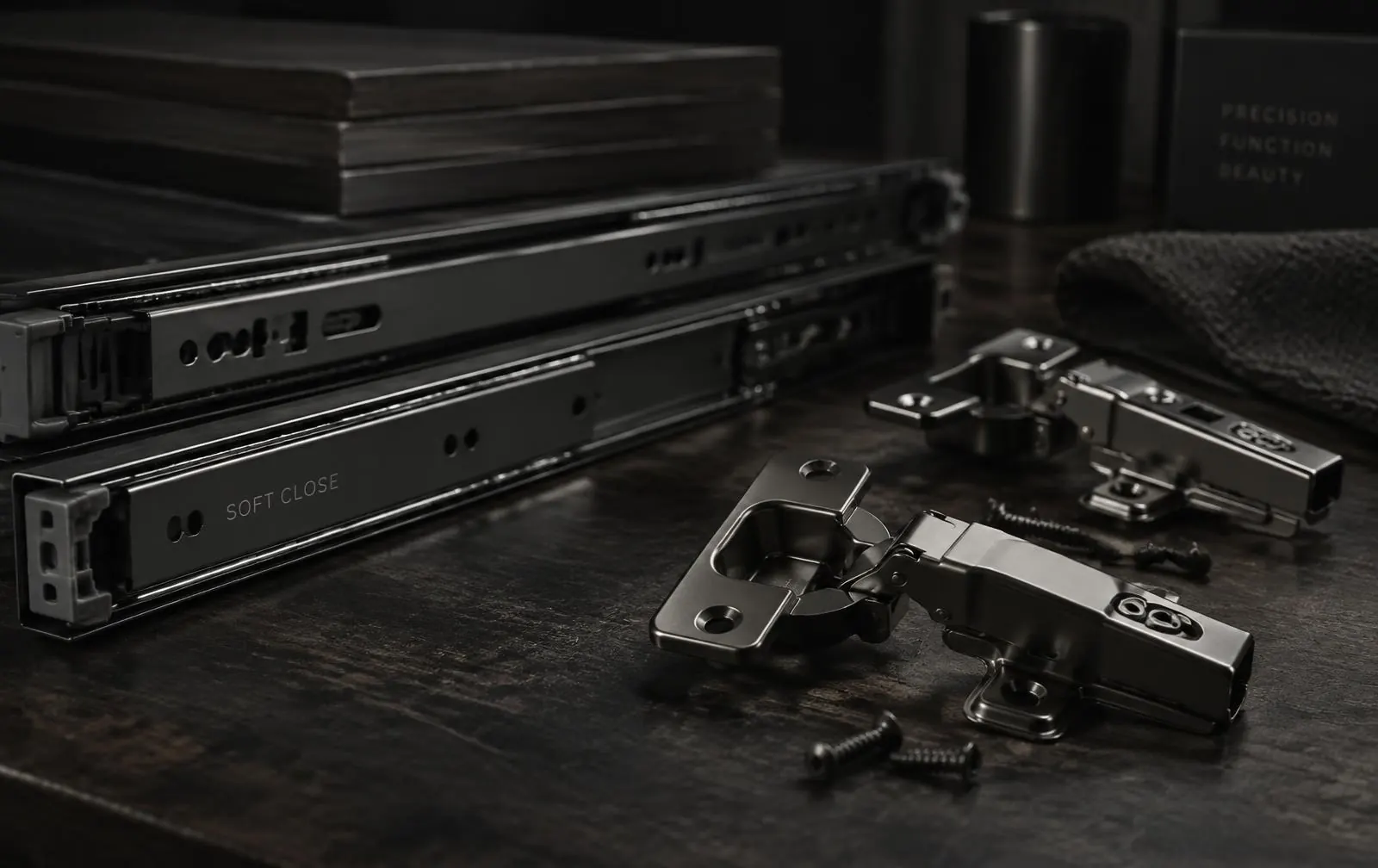
Concealed hinges: three directions of adjustment
A standard concealed hinge adjusts in three directions: sideways (the gap between fronts), in depth (how the front sits against the carcass) and in height (the front's line). The order matters: first height across the whole composition, then side gaps, and depth only at the end.
For a tall or heavy front, three or four hinges are required, often in a reinforced version. An underrated hinge looks correct at first, but after a few weeks the bottom of the front drops and the gap becomes wedge-shaped.
Drawer systems and load ratings
Drawer systems differ not only in price but in rated load (typically 30, 40, 50 or 70 kg), extension type (partial or full) and damping behaviour. A lower kitchen drawer with pots has different requirements from a wardrobe drawer holding textiles.
During installation we verify that runners are exactly parallel and at the same height — a deviation of fractions of a millimetre is felt as friction. A fully loaded drawer must return quietly and stop without a knock.
Push-to-open and handleless systems
Handleless fronts require tighter tolerances than fronts with handles: there is nothing to pull, so every deviation is felt immediately. Mechanical push-to-open needs a precise gap between front and carcass; electric systems also need a planned power supply, which has to be known at design stage.
With heavy solid timber or stone fronts, mechanical push-to-open is often unreliable — in those cases we choose a reinforced or electric system and discuss it before ordering, not on installation day.
Gaps: where a tidy result is born
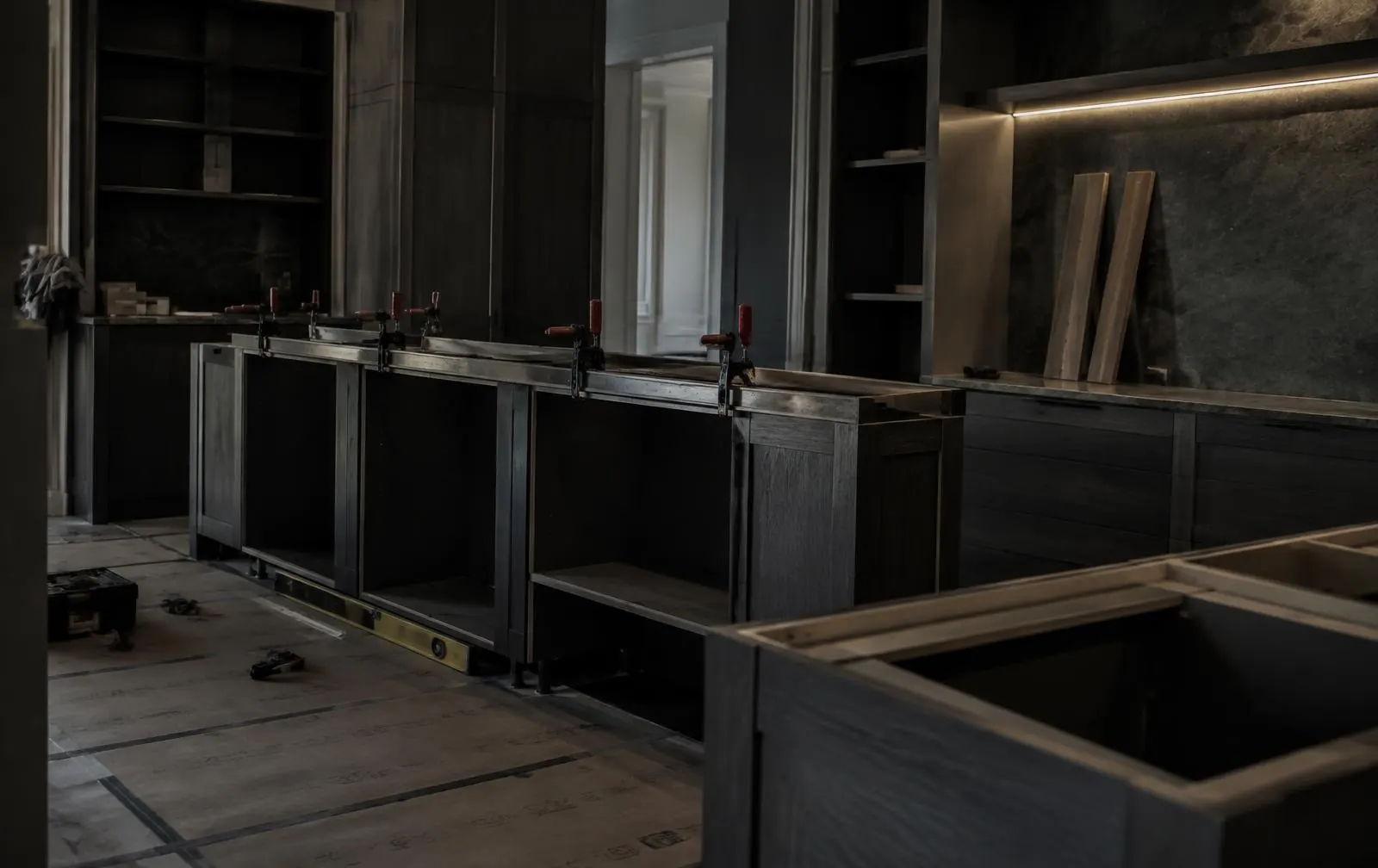
A tidy result is not about beautiful fronts but about even gaps. We set one gap value for the whole composition (usually 3 or 4 mm) and keep it from the first component to the last. We finish adjustment by stepping back and squinting — that way the eye reads the line rather than a single part.
The most common hardware problems after a year
Heavy fronts that have dropped, loose mounting plates, dampers clogged with dust, drawer fronts over-tightened. Nearly all of these are solved in a single visit if noticed early. That is why we always explain to the client how to recognise the first signs.
We recommend a preventive check 6-12 months after installation, especially in new buildings where the structure is still settling and room humidity changes most during the first year.